

Start with the right question
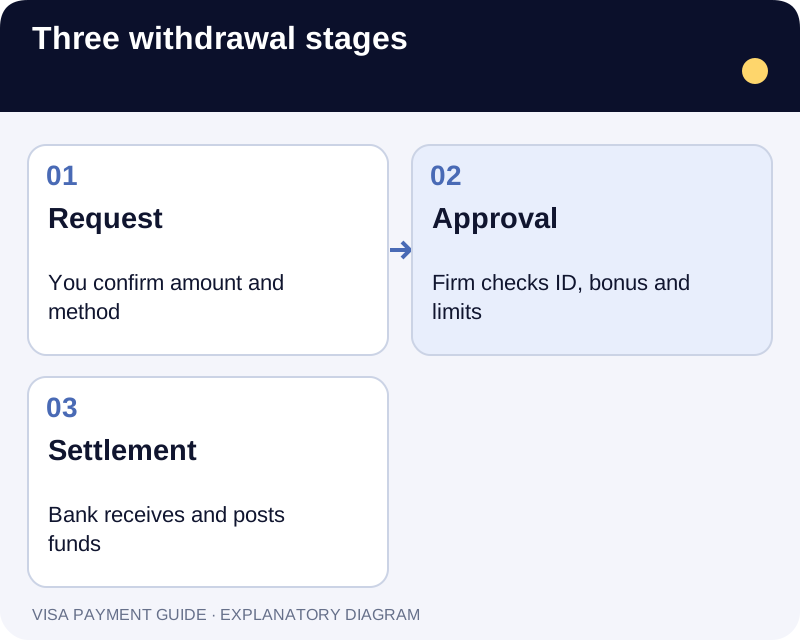
A Visa withdrawal is three separate events: your request, the firm's approval, and your bank's settlement. Delay or shortfall can occur at any stage. Treat the cashier as a record, not a promise.
This guide helps you build a case file. It explains which rules apply in Great Britain, what proof to keep, and how to challenge a fee or a missing amount without guessing.
Great Britain, the UK and which rule applies
Gambling law and the Gambling Commission's licence conditions apply in Great Britain: England, Scotland and Wales. Northern Ireland has a different regime. The UK is a wider legal term, so a UK-facing brand may not hold a GB licence.
Check the firm's entry on the Commission's public register before relying on GB protections. Our guide to checking a licence explains what the register does and does not show.
Fees and the whole-deposit rule
The Commission's guidance on maximum withdrawal limits says firms must not impose arbitrary caps on withdrawing your deposit balance, including winnings derived from it. Reasonable limits on the number or size of partial withdrawals may be allowed where they reflect cost.
The same guidance separates that from fees. A firm may charge a cost-reflective processing fee for a partial withdrawal if it is transparent before you deposit and does not exceed the direct processing cost. But the guidance states that players must not be charged to withdraw their entire deposit balance. Do not weaken that exception: a fee on the full deposit balance is a specific concern to raise, not a normal cost of doing business.
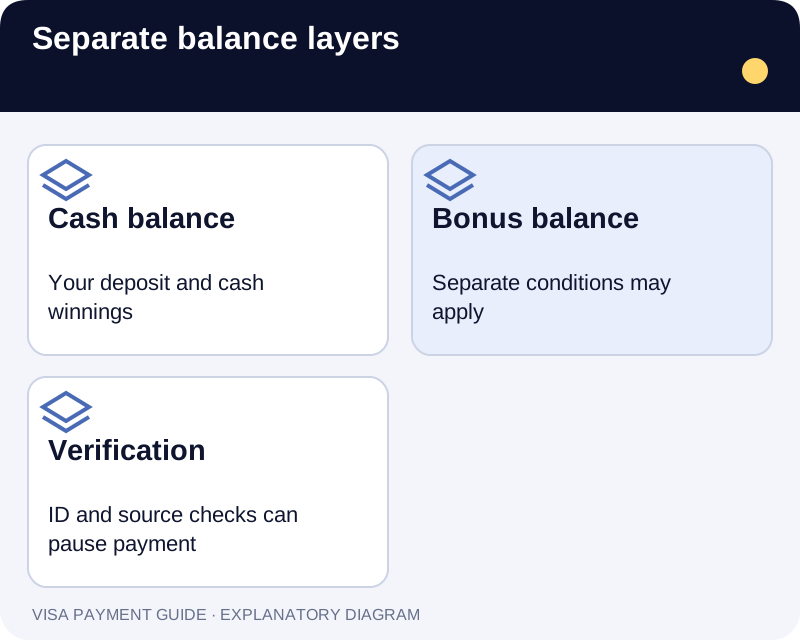
Two more distinctions matter. First, bonus balance is separate from cash and deposit balance; wagering conditions cannot be imposed on your own deposit balance. Second, anti-money-laundering and identity checks may still delay a payment. A lawful check is not the same as an unexplained fee.
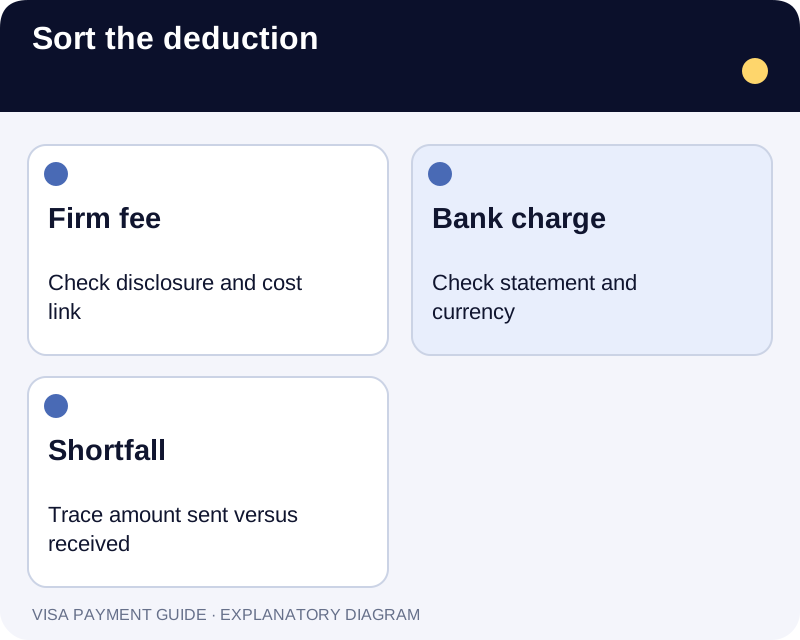
Compare the three possible deductions
| Deduction | Who applies it | What to check | Typical evidence |
|---|---|---|---|
| Firm processing fee | The gambling firm | Was it shown before deposit? Is it cost-reflective? Does it apply to a partial or whole-deposit withdrawal? | Cashier terms, pre-deposit screen, receipt showing fee line |
| Bank or card charge | Your bank or card issuer | Is the payment in GBP? Is a foreign transaction or conversion fee shown on your statement? | Bank statement, tariff, message from issuer |
| Shortfall or disputed amount | Unclear until traced | Was the full approved amount sent? Is a trace reference available? | Approval notice, payment reference, bank search result |
Keep these categories apart in your complaint. A bank fee is not the firm's fee, and an unexplained shortfall is not proof of either.
Evidence to gather before you complain
Build a simple file. Record the request time, amount, method and cashier status. Save screenshots with visible dates. Keep chat and email references. Note your registered name, cardholder name and the last four digits of the card.
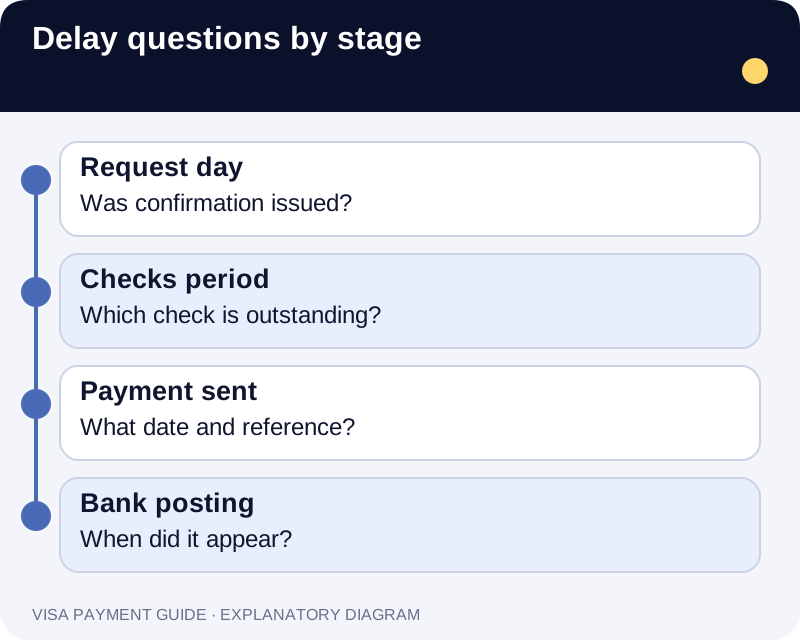
If the firm says it has sent the payment, ask for the trace information: payment date, amount sent, currency and any reference. You need that to ask your bank to search. Do not pay an extra release deposit; a demand for extra money to release an approved withdrawal is a warning sign to verify independently.
Identity checks are a common hold point. The Commission's guidance on age and ID verification explains what firms must do. Our page on identity checks covers documents and mismatches.
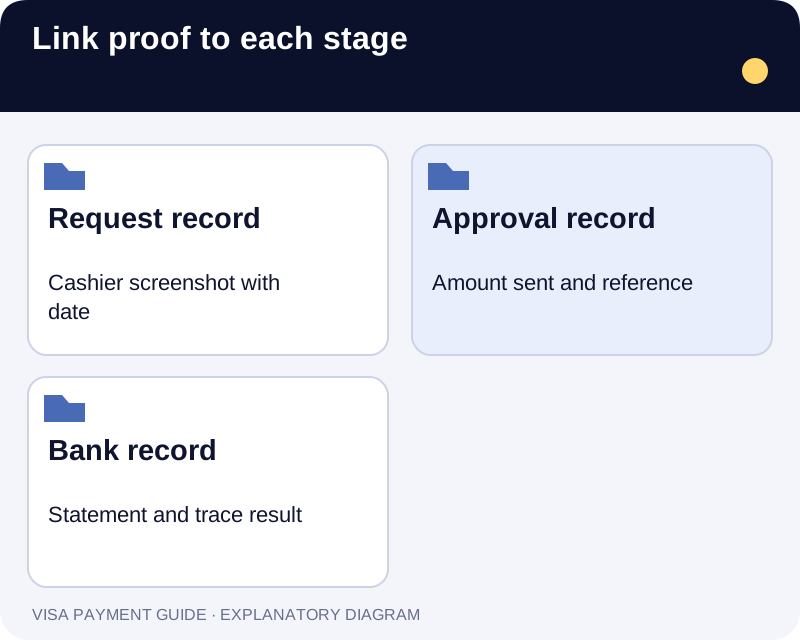
Table of proof by stage
| Stage | What you should hold | What it proves | What it cannot prove |
|---|---|---|---|
| Request | Cashier screenshot, confirmation email | Amount and time requested | That the firm approved it |
| Approval | Approval message, fee line, payment reference | Amount the firm says it sent | That your bank received it |
| Settlement | Bank statement, trace result | What arrived and when | Why any difference arose |
Ask for missing items in writing. A short, specific request works better than a long account of frustration.
Worked reconciliation: an illustrative case
The following is illustrative, not observed customer data. Suppose you request £100, the firm states a £0 operator fee, and no currency conversion is assumed. The firm says it sent £100.
If £100 arrives, the stages reconcile. If £97 arrives, do not assume a firm fee. Check the bank statement for a separate charge and ask the firm for the amount and currency sent. If the firm says £100 was sent but £97 arrived, ask your bank to trace the payment using the reference.
| Line | Amount | Question to ask | Next step |
|---|---|---|---|
| Requested | £100 | Was the request confirmed? | Save cashier screenshot |
| Operator fee | £0 | Is that the current stated fee? | Save terms and approval notice |
| Sent (firm's figure) | £100 | What date, currency and reference? | Request trace information |
| Received | £97 | Is a bank charge shown separately? | Ask bank to trace; keep statement |
A partial withdrawal fee is a separate question. Ask whether a fee applies, its exact amount, and whether it reflects direct processing cost. Ask where it was disclosed before deposit. If the answer is unclear, put the question to the firm in writing.
For card-specific disputes, see our guide to card payment disputes.
Why a Visa withdrawal can be delayed
Common causes include incomplete identity checks, a name mismatch, an active bonus, a cashier limit, or ordinary bank processing. A pending status is not proof of wrongdoing. But a long unexplained wait justifies a written query.
- Check that your ID and address documents are current and approved.
- Confirm the card on file is in your own name.
- Read the current cashier terms for fees and limits.
- Bonus balance is separate from cash and deposit balance; wagering conditions cannot be imposed on your own deposit balance.
- Record the request time and amount.
If the delay follows a bank block or a gambling payment block, the cause may sit with your bank. Our page on gambling payment blocks explains the difference between a firm hold and a bank block.
Old, expired or replaced cards
If your card has expired or been replaced, the firm and your issuer handle the return. Do not assume a new card receives the funds automatically. Ask the firm which card and account it sent the payment to, and ask your issuer how it treats payments to a closed card.
Where a payment has already been sent, request trace information rather than sending more money. A replacement card may be linked to the same account, but that is a question for your issuer, not a guarantee.
Complaints: firm first, then the stated route
Tell the firm's support team and keep the reference. If unresolved, make a formal complaint. After a final response or the applicable eight-week period, check eligibility for the firm's stated independent dispute route. This is usually an alternative dispute resolution provider listed in its terms. The Commission's guidance on how to complain sets out the expected sequence.
Our page on withdrawal complaints covers how to frame a short, evidence-led complaint. We do not process payments or resolve disputes.
Quick checks before you request
- Confirm the card and account are in your own name.
- Check that identity and address documents are approved.
- Read the current cashier terms on fees and limits.
- Check whether an active bonus changes what you can withdraw.
- Note whether the payment is in GBP.
- Record the request time and amount.
These steps do not guarantee speed. They make a later problem easier to prove.
FAQ
Can a firm charge me to withdraw my whole deposit balance?
The Commission's guidance says players must not be charged to withdraw their entire deposit balance. A cost-reflective fee for a partial withdrawal may be allowed if it is transparent before deposit and does not exceed direct processing cost. Ask the firm to identify the rule and the disclosure it relies on.
Why is my Visa withdrawal still pending?
Ask which processing stage the firm’s pending status describes; labels differ between firms. Identity checks, a name mismatch or an active bonus can hold it. Ask for the specific reason in writing and keep the cashier screenshot. A pending status alone does not prove a breach.
What if the amount that arrives is less than I requested?
Separate three causes: a firm fee, a bank or conversion charge, and an unexplained shortfall. Check your statement for a separate charge. Ask the firm for the amount, currency and date sent, plus a trace reference. Then ask your bank to search.
Can my withdrawal go to a different card?
Firms often return funds to the card used, but do not assume a same-card guarantee. If your card expired or was replaced, ask the firm and your issuer how the payment is handled. Request trace information for any payment already sent.
Where do I complain if the firm does not resolve it?
Complain to the firm first. Keep the reference it gives you. If the complaint stays unresolved, use the independent dispute route set out in its terms. That is usually an alternative dispute resolution provider. The Commission’s complaint guidance describes this sequence. We do not handle disputes or payments.
Source and review note
We reviewed the Commission’s public pages on 14 November 2026. We looked at maximum withdrawal limits. We checked restrictions on withdrawing deposits and deposit winnings. We also looked at age and ID verification, and how to complain. This is a dated document review. It is not a test of any firm, bank or complaint. Rules and terms can change, so check the current version before you act.