

You paid a gambling firm by Visa card. The payment is wrong, or the money has vanished. Start by sorting the event into the right legal box. A genuine unauthorised payment is not the same as an authorised deposit you regret.
Then gather proof that ties each transaction to your account records. Your card issuer and the firm’s complaint route handle different issues. A Visa chargeback is a scheme process, not a guaranteed refund of gambling losses.
Name the event before you complain
The first decision shapes everything else. Ask what actually went wrong when your card was used. The answer points to a specific remedy, a specific evidence trail and a specific complaints route.
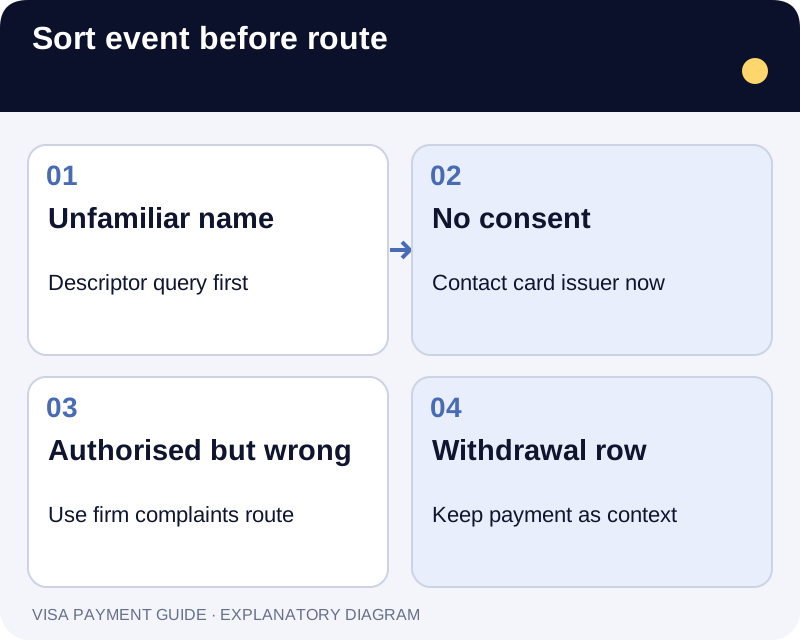
An unauthorised payment means someone used your card or account without your consent. An authorised payment means you approved it, even if you later disputed the service. The distinction matters because your card issuer’s duties differ sharply between the two.
An unrecognised descriptor is not automatically fraud. A trading name may differ from the brand you know. Check statements, emails and the firm’s own records before calling it unauthorised.
A service dispute covers events after an authorised deposit. Examples are a refused withdrawal, a disputed balance or a locked account. These are usually complaints against the firm first.
- Fraud claim: you did not authorise the card use.
- Descriptor query: the payment is real but unfamiliar in name.
- Service complaint: you authorised the deposit but dispute the outcome.
- Balance or withdrawal row: the card payment is not the real grievance.
Write one sentence describing your own case. Use it at the top of every letter and message. This keeps the trail clear when several teams reply.
Three routes, three different tests
People often use “chargeback” as a synonym for refund. It is not. Visa’s public chargeback page explains a scheme for resolving card disputes between banks and merchants. It does not create a statutory right to a gambling refund.
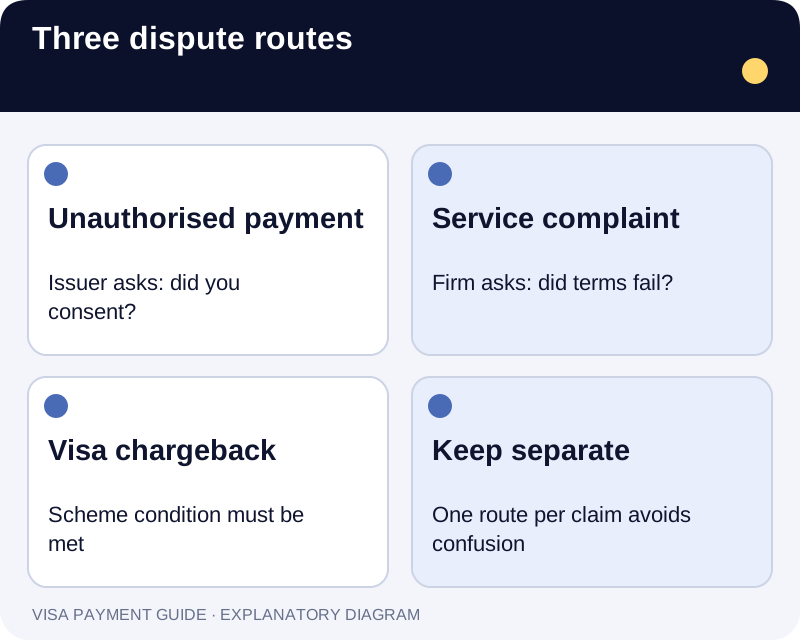
The table below sets out the starting distinctions. It is a comparison of routes, not a promise that any route will succeed.
| Route | Core question | First contact | Key evidence |
|---|---|---|---|
| Unauthorised payment | Did you consent to this card use? | Your card issuer, immediately | Bank statements, device and login history, time-stamped messages; the issuer assesses consent |
| Service complaint | Did the firm meet its terms and consumer rules? | The gambling firm’s complaints team | Account statements, consent records, chat logs, terms at the time |
| Visa chargeback | Does the scheme’s dispute condition apply? | Your card issuer after an initial complaint | Transaction data, merchant replies, prior complaint record |
Keep these routes separate in your letters. Mixing them gives the other side an easy reason to send a generic reply.
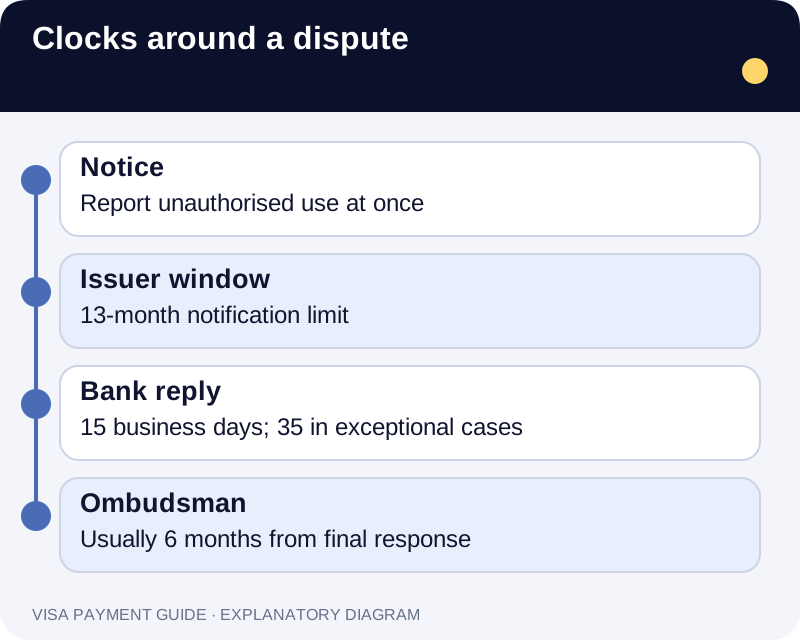
Chargeback time limits are separate from the 13-month unauthorised-payment notification rule and the six-month Financial Ombudsman Service window. A card-scheme chargeback deadline is often around 120 days, with the start date and any exception depending on the claim. Ask your issuer promptly to confirm the exact deadline; do not wait for an eight-week operator process before checking it. See Visa's chargeback guidance.
Fraud: the clock starts at once
The FCA's consumer page on fraudulent payments says to contact your card issuer immediately if you notice an unauthorised payment. It also notes a 13-month notification limit. Those are starting points. Evidence and exceptions still apply.
For an unauthorised payment, the FCA describes a refund starting point of the end of the next business day after the issuer is told, subject to the applicable exceptions. The issuer may assess consent and relevant evidence, but an investigation does not erase the refund rules. Do not present a dispute as fraud if you authorised the payment. False claims damage your own case file.
Expect the issuer to ask when you first noticed the payment and what devices were involved. Keep your answers consistent. Save the date and time of each call and the reference number you are given.
- Report the card as compromised if you truly did not consent.
- Follow your issuer’s instructions to secure the card and account, including freezing or replacing the card where needed.
- Preserve emails, app messages and login alerts.
- Record each contact: date, team, reference and what was said.
If you suspect fraud, contact your card issuer immediately. Tell them the date, amount and any reference. Keep a copy of what you send. Record their response and any deadline they give you.
Authorised payments: why retail refund habits mislead
Many people assume a card payment can be reversed like a faulty purchase. Gambling deposits rarely fit that template. The money was often credited to a betting balance and then used.
The Financial Ombudsman Service decision DRN-5895148, which we inspected on 14 November 2026, illustrates the point. It concerned Wise debit transactions from January and February 2025. The consumer had accepted authorisation. Incorrect merchant category codes did not create a successful chargeback right. The ombudsman declined the complaint on its facts.
That is a case-specific decision, not a universal rule and not an independent test of a casino. It shows why a descriptor or category error alone may not reopen an authorised payment.
If your complaint is about a refused withdrawal or blocked account, the card payment itself may not be the right target. Use the firm’s internal complaint route first and keep the payment records for context.
Build an evidence file that answers the test
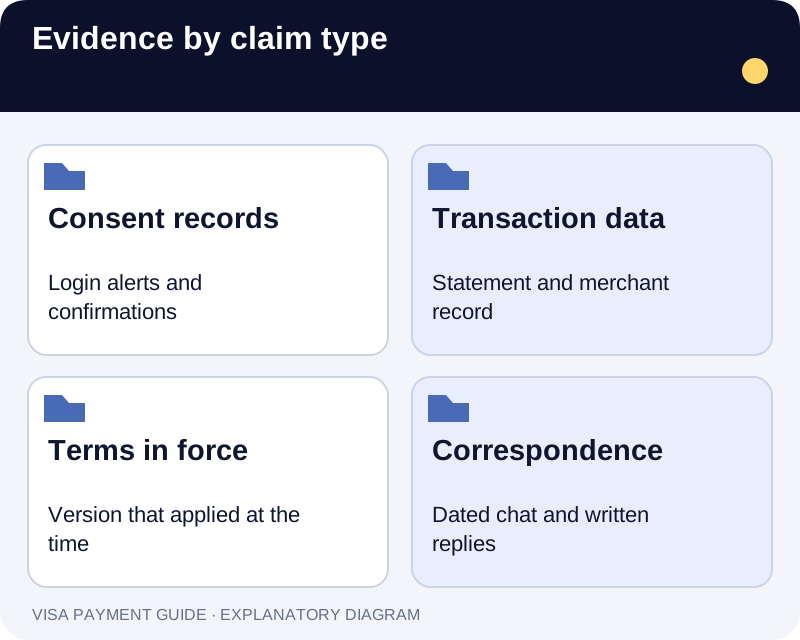
Evidence must match the claim. Fraud evidence differs from service evidence. A long narrative with no dates is weaker than a short chronology with attachments.
Make a one-page summary. List each disputed transaction by date, amount and the last four digits only. Then list what you say happened and which document proves it. Do not send your full card number or account password in any message.
| Claim | Strong evidence | Weak or irrelevant material |
|---|---|---|
| I did not authorise this payment | Issuer fraud report, login alerts, device records, timeline of where your card was | Screenshots of unrelated offers, general complaints about the firm |
| I authorised it but the firm failed its terms | Account statement, terms version in force, chat logs, withdrawal requests | Angry posts, claims about other customers |
| The descriptor is unfamiliar | Merchant reply, receipt email, statement entry, firm’s trading name | Assumption of fraud without checking |
Keep original files. Do not crop timestamps out of screenshots. If a chat log matters, export it whole where the firm allows.
Desk analysis: a worked illustrative example
The following example is illustrative. It is not observed customer data and says nothing about any real firm, bank or person.
Suppose a consumer sees three Visa debits of £40 on their statement. The descriptor is unfamiliar. They first say the payments are fraud. Then they search their records and remember personally approving each of those three deposits. A login and a confirmation email match the dates too. The case changes box: on the consumer's own account these were approved payments, though the descriptor confused them.
A fraud report alone may now fail, because the issuer’s question is consent. The real issue may be a service complaint about a balance or withdrawal. The evidence file should pivot: deposit confirmations, account statement, chat logs and terms. A chargeback request should not rest on a false fraud claim.
| Fact in the example | What it suggests | Next step |
|---|---|---|
| Unfamiliar descriptor | Descriptor query, not proof of fraud | Ask the firm to confirm its trading name |
| Payer remembers personally approving each deposit, and the confirmation email matches the dates | Approved on the consumer's own account; the issuer still assesses all evidence | Treat as authorised; correct any fraud report |
| Withdrawal request refused | Service complaint about the account | Use the firm’s complaints route; preserve records |
| Issuer already told it was fraud | Inconsistent file | Correct the record in writing, with the evidence |
The lesson is simple. Check consent records before choosing the complaint label. A mistaken label can delay the real issue.
Complaints to the firm and to your bank
FCA guidance on how to complain explains that firms normally have 15 business days to give a final response, extending to 35 business days in exceptional cases. These deadlines concern payment-service complaints; other bank complaints can follow different time limits. Gambling operator complaints follow a separate route.
Gambling firms in Great Britain usually have their own eight-week complaint window before the consumer can go to an ADR provider. Northern Ireland and UK-wide differences can matter. The UK includes Scotland, Wales, Northern Ireland and England. Great Britain excludes Northern Ireland. Check which regulator’s rules cover the firm before citing a deadline.
If your complaint is about a payment service, use the bank’s formal complaints process. The FCA page on complaining sets out the final response route and the usual six-month window to take a case to the Financial Ombudsman Service after that final response.
- Write to the right team: fraud, payments complaints or customer care.
- Ask for a final response in writing.
- Keep the envelope and the date of every reply.
- Do not send the same bundle to two routes at once without saying so.
Identity checks can slow a payment complaint. Our explainer on identity checks covers why firms ask for proof before releasing or reviewing funds.
When to check a licence or regulator
Before you frame a complaint, confirm who regulates the firm. In Great Britain, the Gambling Commission licenses most commercial gambling operators. Local authorities license some premises. Check names, trading styles and status on the public register.
Use the licence checker to match the exact legal entity on your statement. A brand name may sit above several companies. This matters if you later cite rules or ask a regulator to look at the case.
Our guide to checking a gambling licence explains how to read the register without guessing. Do not treat a licence number as proof that a particular payment must be refunded.
What not to do
Do not tell your bank a payment was unauthorised if you approved it. Do not ask a firm to re-code a payment to create a dispute. Do not claim a chargeback right that the scheme does not give. These moves can backfire and obscure a genuine complaint.
Avoid promising yourself a recovery. Visa’s chargeback page describes a resolution scheme. The FCA’s fraud page describes the unauthorised payment route. Neither guarantees a refund of gambling losses.
Keep language factual. “I authorised the deposit but dispute the refused withdrawal” is a better sentence than a long accusation. Short, dated points are easier to answer.
Keeping the file usable
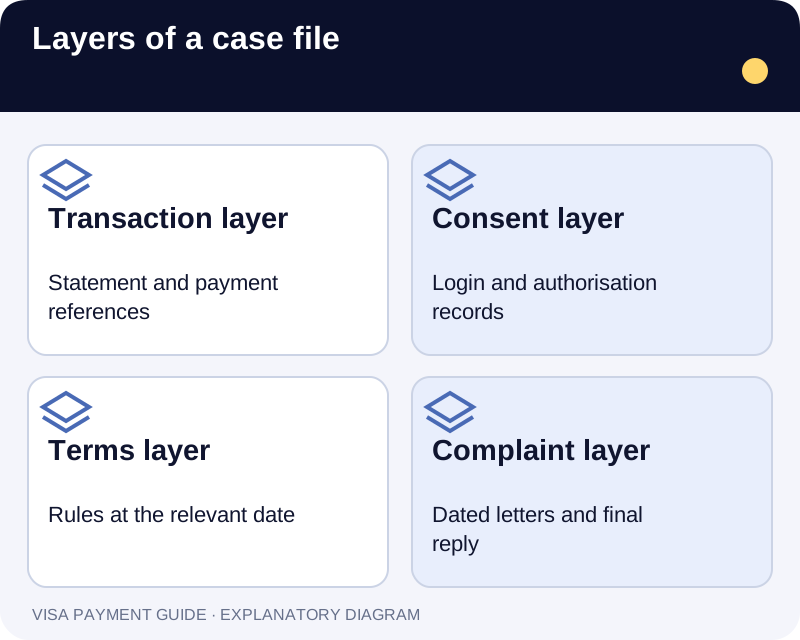
Store one folder with numbered documents. Name files by date and type. Write a one-page index. Keep a contact log with names, teams and reference numbers.
When you get a reply, answer only the points raised. Quote the document number you rely on. Ask for the specific rule or term the firm used. If the reply is unclear, request a written final response.
Payments can involve several parties: your bank, the acquiring bank and the merchant. A card payment dispute may need the firm’s transaction data. Ask for it in plain terms.
If a payment block is the issue, read our guide to gambling payment blocks. For withdrawal issues, see Visa withdrawals. These pages help you separate account problems from card disputes.
FAQ
Can I charge back a gambling deposit I authorised?
You can ask your issuer about a card dispute, but an authorised deposit is not automatically reversible. The card scheme’s conditions and the evidence of consent matter. A service complaint about the firm’s terms may be the better route. A chargeback is not a guaranteed refund of gambling losses.
What if the statement descriptor is unfamiliar?
Check emails, account history and the firm’s trading name first. An unfamiliar descriptor is a query, not proof of fraud. Ask the firm to confirm the name it uses. If you still believe the payment was unauthorised, contact your card issuer immediately and keep the reply.
How long does a bank have to answer a payment complaint?
FCA guidance says payment firms normally give a final response within 15 business days, or up to 35 in exceptional cases. These deadlines concern payment-service complaints, not every complaint about a bank. Gambling operators’ own complaint windows are separate. Always ask for the final response in writing.
Can the Financial Ombudsman review a gambling payment case?
It can consider complaints about firms it covers, once you have a final response or the relevant period has passed. The usual window is six months from the final response. A case-specific decision such as DRN-5895148 does not guarantee the outcome of yours.
Does Great Britain differ from the UK here?
Great Britain covers England, Scotland and Wales. The UK adds Northern Ireland. Gambling regulation and some complaint routes differ. Payment firm rules from the FCA apply more widely. Check the exact jurisdiction of the firm and the route before citing a rule or deadline.
Document review and limits
We inspected the FCA fraudulent payments page, the FCA how-to-complain page, Visa’s chargeback page and Financial Ombudsman decision DRN-5895148 on 14 November 2026. Those dates are our review dates, not source publication dates. This article is general information, not legal or financial advice. It does not collect card or account details.
Sources reviewed: Visa chargeback overview; Financial Ombudsman decision DRN-5895148; FCA guidance on fraudulent payments; FCA guidance on how to complain.