

A bank gambling block is a card control. It tells your bank or card firm to refuse certain gambling payments. It is not the same as self-exclusion, a GAMSTOP registration, or a device-level block.
Scope and cooling-off periods vary by firm. Check your bank's current instructions. If a payment gets through, keep proof and ask the firm to investigate. Do not test the block by placing a bet.
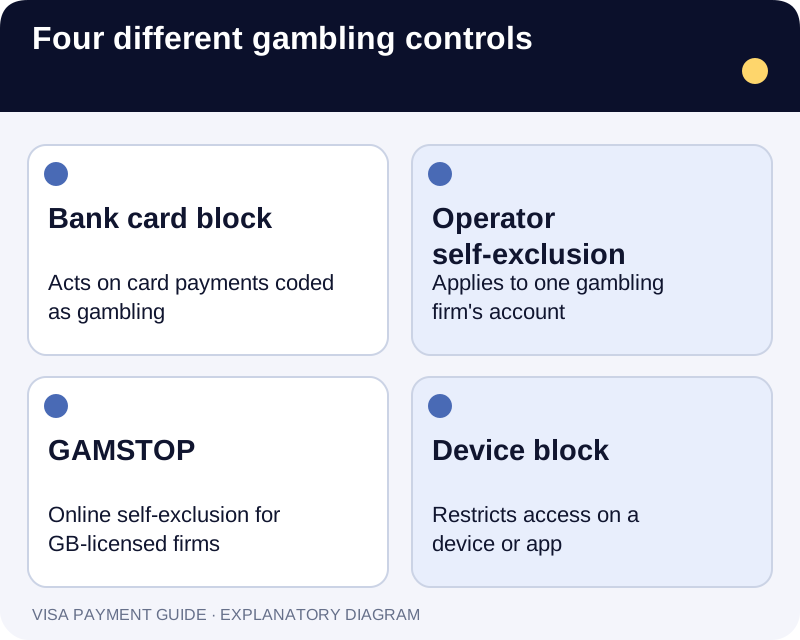
What a bank gambling block actually does
Your bank or card issuer applies a rule to your debit or credit card. When a payment looks like gambling to the firm's systems, the card should decline it.
Many controls rely on merchant category identification. That means the firm checks how the payment is coded. A payment coded as gambling should be blocked. A payment coded differently may pass.
This is why a block is not a wall around your whole bank account. It usually covers card payments. Transfers, direct debits and some other payment types may sit outside it.
The Gambling Commission's public guidance explains that blocks are one option among several. It points people to their bank for the exact scope of the control. See the Commission's page on how to block gambling transactions.
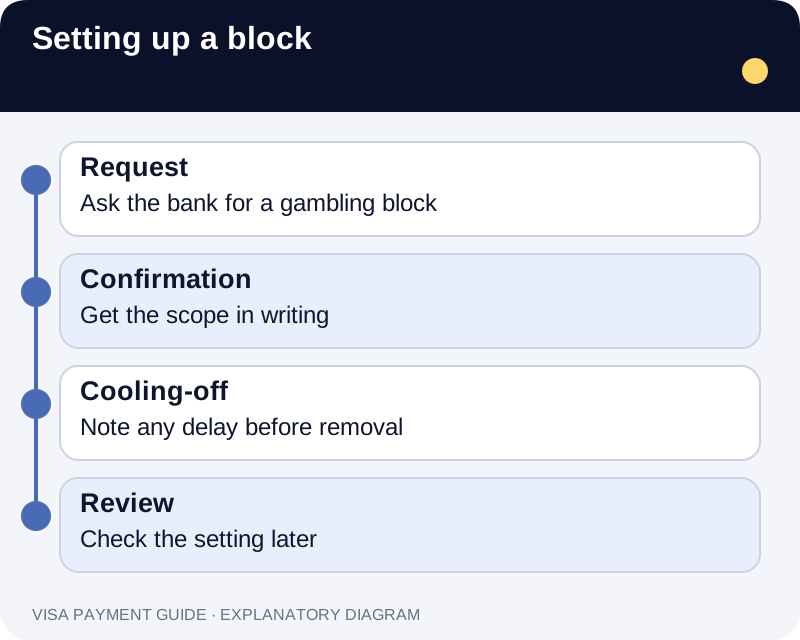
Cooling-off periods are not universal. Some firms apply a delay before a block can be removed. Others may not. Ask your firm what applies to your account, and get the answer in writing if you can.
Block, self-exclusion and GAMSTOP: key differences
These controls are often confused. They operate at different points and have different limits. The table below sets out the main distinctions.
| Control | What it acts on | Who applies it | Main limit |
|---|---|---|---|
| Bank card block | Card payments coded as gambling | Your bank or card firm | May not cover transfers or differently coded payments |
| Operator self-exclusion | Your account with one gambling firm | That firm | Applies only to that operator |
| GAMSTOP | Online gambling with participating GB-licensed firms | GAMSTOP scheme | Not blanket worldwide coverage |
| Device or software block | Access to gambling sites or apps on a device | You or a third party | Can often be removed or bypassed |
GAMSTOP is a self-exclusion scheme for online gambling. It relates to participating firms licensed in Great Britain. It does not cover every gambling service worldwide. The scheme's own site explains what GAMSTOP covers.
Great Britain and the UK are not the same for licensing. Gambling law in Great Britain covers England, Scotland and Wales. Northern Ireland has a separate regime. A GB-licensed firm is not the same as a UK-wide one. This matters when you check which self-exclusion schemes apply.
A bank block can sit alongside these tools. It does not replace them. Layering controls gives more than one point of resistance.
Check your settings without placing a bet
You can confirm a block is active without gambling. Ask your bank to confirm the setting on your account. Use secure in-app chat or a branch visit. Keep the confirmation.
Do not place a small bet to test the block. That defeats the purpose and creates a payment you may regret. A confirmation from the firm is better proof than a trial transaction.
Ask three questions. Which payment types does the block cover? Does it apply to all cards on the account? Is there a cooling-off period before removal? Write down the answers and the date.
- Ask for the block's scope in writing: card payments, transfers, or both.
- Confirm whether joint cards or additional cardholders are covered.
- Note any cooling-off period and how removal would be requested.
- Save the confirmation message or letter in your case file.
If you also use GAMSTOP, check your registration status directly with the scheme. Do not assume a bank block and a GAMSTOP registration share data. They are separate systems with separate records.
If a gambling payment gets through
A payment may pass for several reasons. The merchant code may not match the firm's gambling category. The payment may be a transfer rather than a card payment. A replacement card may not carry the setting. Or the block may not have been applied as you asked.
Do not try to force a second payment to test the rule. Keep the evidence you already have. Then ask your bank to investigate the specific transaction.
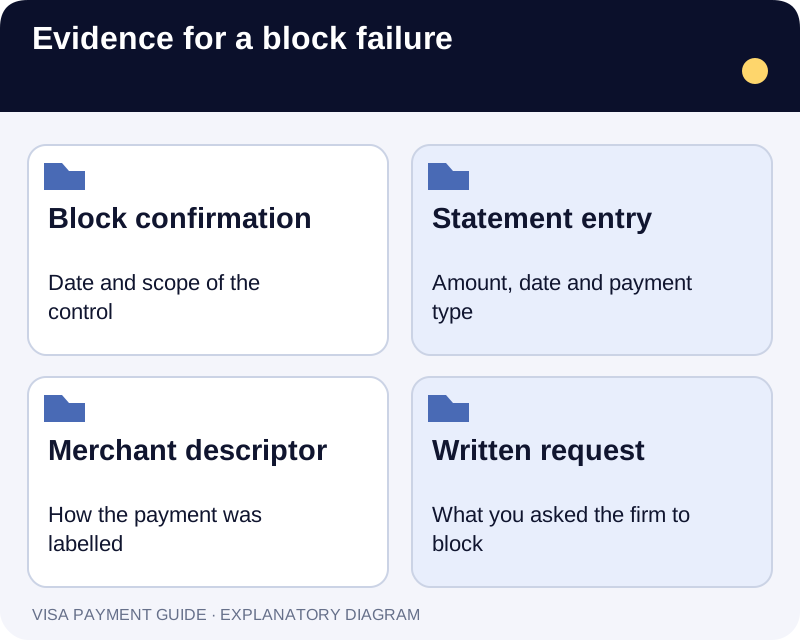
Your case file should show what you asked for, what you were told, and what happened. The table below sets out useful evidence and why it matters.
| Evidence | What it shows | Why it helps |
|---|---|---|
| Block confirmation | Date and scope of the control | Shows what the firm agreed to do |
| Bank statement entry | Amount, date and payment type | Identifies the transaction in dispute |
| Merchant descriptor | How the payment was labelled | Helps explain why coding may have differed |
| Your written request | What you asked the firm to block | Shows the instruction you gave |
Ask the bank to explain why the payment was allowed. A clear answer helps you decide the next step. It also creates a record if you need to escalate.
If the firm's reply is unclear, ask again in writing. Keep the tone factual. State the date of your request, the confirmation you received, and the transaction you want explained.
For card payments, the firm's complaints process is the first route. The Financial Ombudsman Service can look at unresolved complaints about firms it covers. A published decision, DRN-5895148, shows how the ombudsman reviews a gambling-related payment complaint. It is an example of reasoning, not a guarantee of any outcome.
If your problem is a disputed card payment rather than a block failure, see our guide to card payment disputes. If identity checks are part of the issue, read about identity checks.
Worked example: reading a block failure
This example is illustrative. It is not observed customer data. It shows how to reason from documents rather than assumptions.
Suppose a person asks their bank for a gambling block on 3 March. The bank confirms the block on 4 March. On 20 April, a card payment of £40 to an online gambling firm appears on the statement.
The person checks the merchant descriptor. It does not obviously name a gambling firm. The bank says the payment was coded under a different merchant category. The block applied to gambling-coded card payments only.
The table below shows how the documents support each point. The aim is a clear question to the bank, not a conclusion in advance.
| Document | What it establishes | Question for the bank |
|---|---|---|
| Request dated 3 March | Block was asked for | Was the request recorded correctly? |
| Confirmation dated 4 March | Block was applied | What scope was recorded? |
| Statement entry 20 April | Payment was made | Why was this payment allowed? |
| Merchant descriptor | Payment label | Which category code applied? |
The person should ask the bank to explain the coding and the block's scope. They should not ask for a workaround or a new payment route. The goal is an explanation and, if appropriate, a complaint.
If the bank's answer is that the block only covered certain codes, that is a scope limit. The person can then decide whether to ask for a stronger control. Some firms offer additional settings, but availability varies.
If the answer is that the block should have applied, the person can ask for the payment to be reviewed under the firm's complaints process. Keep the reference number. Escalation to the ombudsman is possible after the firm's final response, within the applicable rules.
Cooling-off periods and removal
A cooling-off period is a delay before a block can be removed. It is designed to slow down a change of mind. Not every firm applies one. Where it exists, the length and terms vary.
Ask your firm two things. Does a cooling-off period apply to your block? What is the process to request removal? Get the answer before you need it.
Do not assume a removal request takes effect at once. If a delay applies, plan around it. A block that is being removed may still decline payments during the delay.
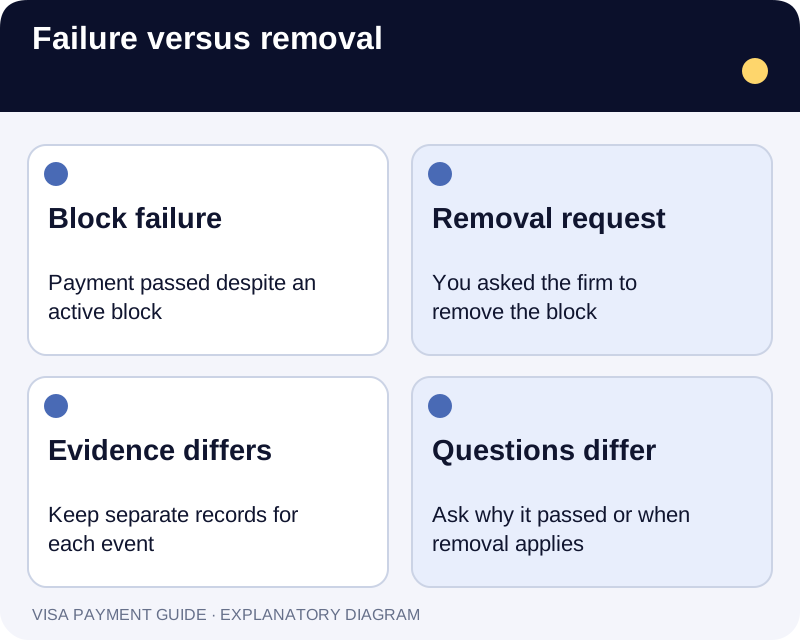
Removal is not the same as a block failing. A removal request is not the effective removal time. Compare the date the bank confirms the block has actually ended with the payment timestamp. A payment after removal has taken effect is not a block failure, but a payment during an active cooling-off delay may still merit investigation against the block's scope. Keep the removal confirmation separate from your block confirmation.
Building stronger protection with your bank
If a block's scope is too narrow, discuss stronger options with your bank. Do not look for ways around a control. Ask what additional settings the firm offers and what each one covers.
Possible layers include a card block, account-level restrictions, and self-exclusion schemes. Availability differs by firm and by account type. Ask for the current terms rather than relying on general descriptions.
Debt and money advice services can help if gambling has affected your finances. MoneyHelper's page on tackling problem gambling and debt explains support options. It is a public information source, not a counselling service run by this site.
If you are checking a firm's licence, use our guide to checking a licence. Licence status matters for which self-exclusion schemes apply.
- Ask the bank which controls cover card payments and which cover transfers.
- Ask whether additional cardholders are included.
- Record each control's start date and any removal delay.
- Keep bank replies with your block confirmation.
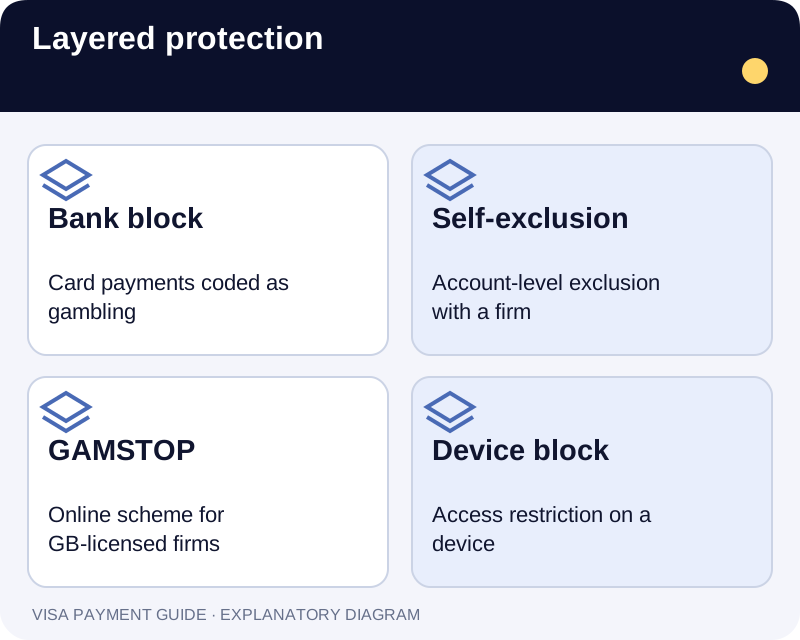
Layering is more useful than relying on one control. A bank block, a GAMSTOP registration and a device-level block each act at a different point. No single layer is complete.
When to escalate and how
Start with your bank's complaints process. State the facts and the outcome you want. Ask for a written response. Keep the reference number and dates.
If the complaint is not resolved, you may be able to take it to the Financial Ombudsman Service. Check whether the firm is covered and whether the time limits apply to your case. The ombudsman's published decisions show how similar complaints are reasoned.
If the issue is a gambling firm's conduct rather than your bank, the Gambling Commission's public guidance explains where to raise concerns. Report regulatory concerns to the regulator. Individual disputes about the gambling firm's service start with that firm. Where eligible, they then go to its ADR provider. The regulator does not recover individual payments.
Do not send original documents. Keep copies. A clear timeline with dated entries is more useful than a long narrative.
FAQ
Is a bank gambling block the same as GAMSTOP?
No. A bank block is a card control applied by your bank or card firm. GAMSTOP is a self-exclusion scheme for online gambling with participating GB-licensed firms. They are separate systems. One does not automatically update the other, so check each separately.
Why did a gambling payment go through despite my block?
The payment may have been coded under a different merchant category, or it may not have been a card payment. Replacement cards and joint cards can also affect coverage. Ask your bank to explain the specific transaction. Keep the statement entry and any block confirmation.
Can I test the block with a small bet?
Do not place a bet to test a block. It creates a payment you may regret and does not prove the setting is correct. Ask your bank to confirm the block in writing instead. Use secure in-app chat or a branch visit and save the reply.
Does a cooling-off period always apply?
No. Cooling-off periods vary by firm, and some firms may not apply one. Ask your bank whether a delay applies to your block and how removal would be requested. Get the answer before you need it, and keep it with your records.
Does GAMSTOP cover every gambling site?
GAMSTOP relates to online gambling with participating firms licensed in Great Britain. It is not blanket worldwide coverage. Great Britain and the UK differ for licensing, and Northern Ireland has a separate regime. Check the scheme's current coverage before relying on it.
Source and review note: We inspected the Gambling Commission's public guidance on blocking gambling transactions, the GAMSTOP website, MoneyHelper's page on problem gambling and debt, and Financial Ombudsman decision DRN-5895148 on 14 November 2026. This article describes those public documents. It does not record any deposit test, bank contact or complaint submission. Rules and firm settings can change. Check current terms with your bank or card firm.