
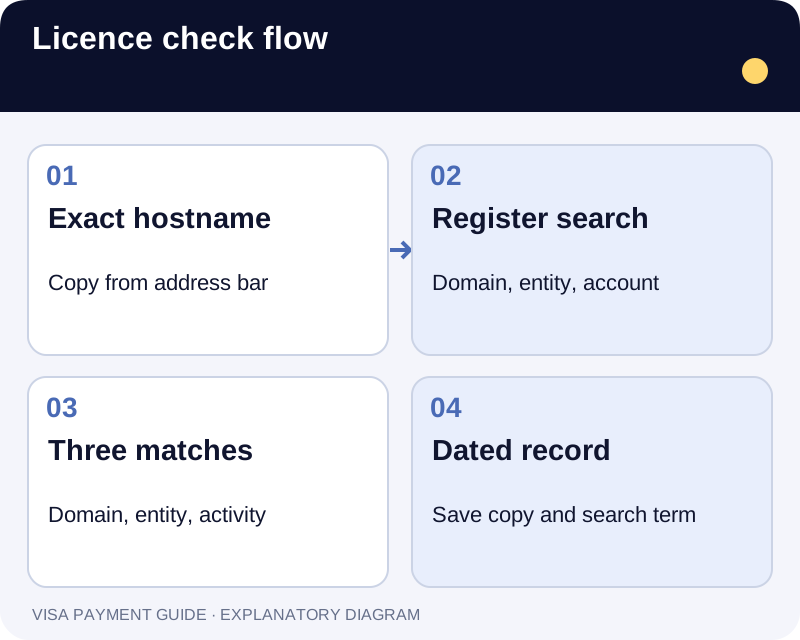
Start with the Gambling Commission public register. Search the exact domain shown in your browser, then the legal company name and the Gambling Commission account number shown in the firm’s licence details. Compare each result with the licence entry. A badge or a Companies House record alone does not prove a gambling licence covers that site.
The register covers Great Britain: England, Scotland and Wales. Northern Ireland has separate rules, so do not treat a GB entry as proof for a Northern Ireland-facing site. Record the exact text you saw, the date and any missing match. Treat a gap as unresolved, not as proof of wrongdoing.
What the public register actually shows
The Commission publishes business entries with licence status, licensed activities and trading names. Its own guidance explains that the register is a search tool, not a safety guarantee. We inspected the public register pages and the Commission's guide to what gambling businesses must do on 14 November 2026.
The register lets you search by business name, trading name, domain and account number. Those fields help because a brand name may differ from the legal entity that holds the licence. A licence entry can also cover several trading names.
The register also records fields that answer separate questions. Compare licence status with domain status and trading name status. Read the activity dates. The register field definitions explain each one.
A small field table shows what to compare:
| Field | What it means | Why it matters |
|---|---|---|
| Account number | Stable business reference | Compare entries; not your player or bank account |
| Account name | Legal name of the licence holder | Match it to the contracting entity in the terms |
| Domain status | Active, Inactive or White label | Check if the domain is Active, Inactive or marked White label. White label describes the business arrangement, not itself a lack of current permission. For a white label, identify the licence holder and contracting firm. |
| Trading name status | Active or Inactive | An Inactive name is not current permission |
| Activity from / until | Dates the activity runs | Compare with the date you paid or played |
Pending is not Active. Suspended, surrendered and revoked statuses are not permission to serve. A White label still needs the licence holder and the contracting firm identified.
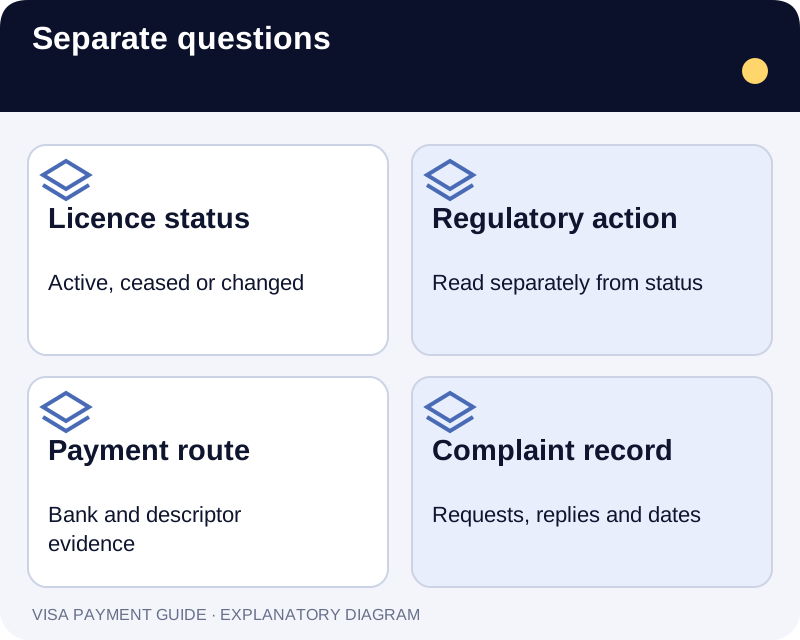
Status matters. An active entry tells you the licence is not shown as lapsed, revoked or suspended at the time you check. It does not by itself prove solvency, fair treatment or that a particular web page belongs to that operator. Read any regulatory action noted on the entry separately.
The Commission says the register includes ceased licences for three years. That is useful for older complaints: a firm may have held a licence when you paid, even if the entry has now ceased. Capture the different statuses rather than assuming a missing entry means no licence ever existed.
Domain and trading names are supplied by the business. The regulator does not guarantee third-party accuracy. A site can display a real licence number that belongs to another business. That is why you compare strings, not impressions.
Domain, entity and activity: three separate matches
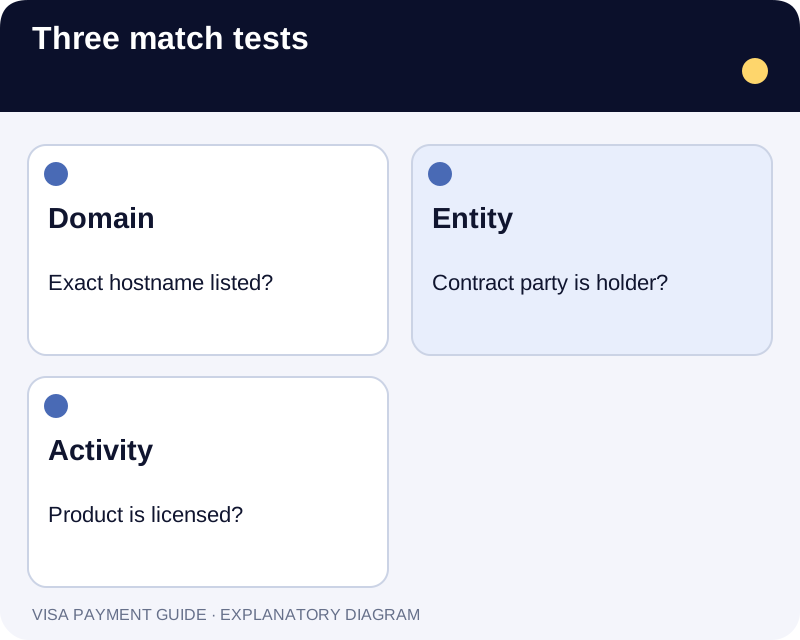
A useful licence check has three parts. First, does the exact hostname appear as a trading name or domain on the entry? Second, does the legal entity named in the site’s terms match the licence holder? Third, does the entry cover the gambling activity you used?
| Evidence | What it can show | What it cannot show alone | Practical check |
|---|---|---|---|
| Gambling Commission register entry | Licence status, holder, activities, listed names in GB | Solvency, fair play or ownership of every similar domain | Search exact domain and legal entity; save dated result |
| Companies House record | Company registration and filing history | Any gambling licence or permission to take bets | Compare company number and name with terms |
| Website footer badge or licence number | A claim made by the site | The claim is true or linked to that hostname | Type the number into the official register yourself |
| Overseas licence | A foreign regulator may authorise activity there | Coverage for customers in Great Britain | Check the GB register separately for GB-facing activity |
Use the same spelling throughout. Copy the hostname from the address bar, without the path or query string. If the site uses a subdomain, check that exact hostname. Check who operates the hostname and which licensed activity applies. A subdomain of a listed domain is not automatically a separate unlicensed business. A lookalike address under another domain is a different hostname.
For example, an illustrative entry may list example.com, while the page you used sits at secure.example.com.payments.example.net. The string is not the same. This example uses reserved domains and describes no live operator. The mismatch is a reason to pause and gather evidence, not a conclusion about intent.
Activity also matters. A licence may cover remote casino and betting but not a lottery product, or vice versa. Read the licensed activities listed on the entry. If the entry does not cover what you used, ask the firm for the legal basis, in writing. Do not rely on a badge.
Identity checks are a separate process from licensing. A firm may hold a valid licence and still ask for proof of identity or address under its duties. If your payment is held, see identity checks and payment holds for the document trail.
Build a dated case file before you complain
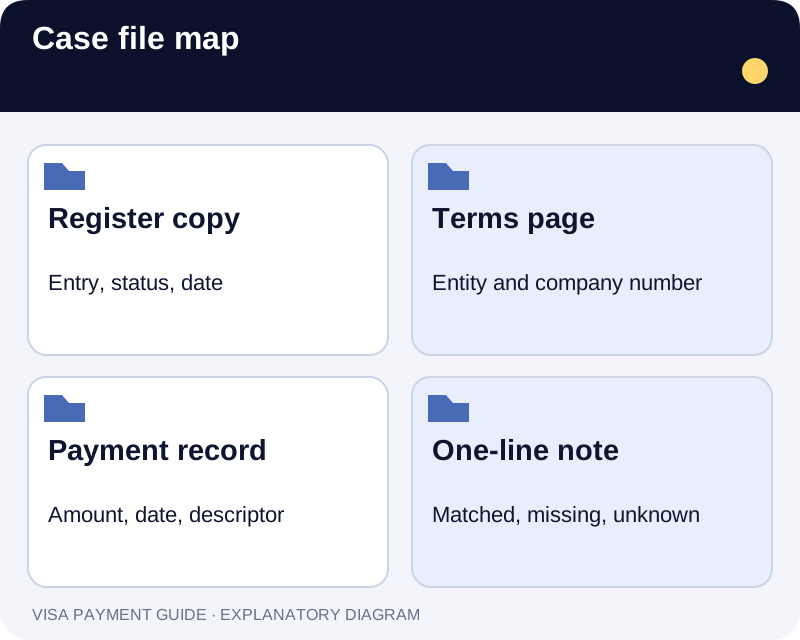
Write down the date and time of your check, in your own time zone. Save the register result as a PDF or a dated screenshot. Copy the exact legal entity, licence number, status, licensed activities and listed trading names. Keep the page address of the register entry with the copy.
- Capture the hostname exactly as shown in the browser, including any subdomain.
- Save the terms page that names the contracting company and its company number.
- Save your payment record, including the account reference or descriptor on your card statement.
- Save the register result with the date and the exact search term you used.
- Write one line stating what matched, what did not, and what remains unknown.
Keep the original files. Do not crop out the address bar or the date. If the site later changes, your copy may be the only record of what you saw. A missing match should be written as “not found on [date]”, not as “unlicensed”.
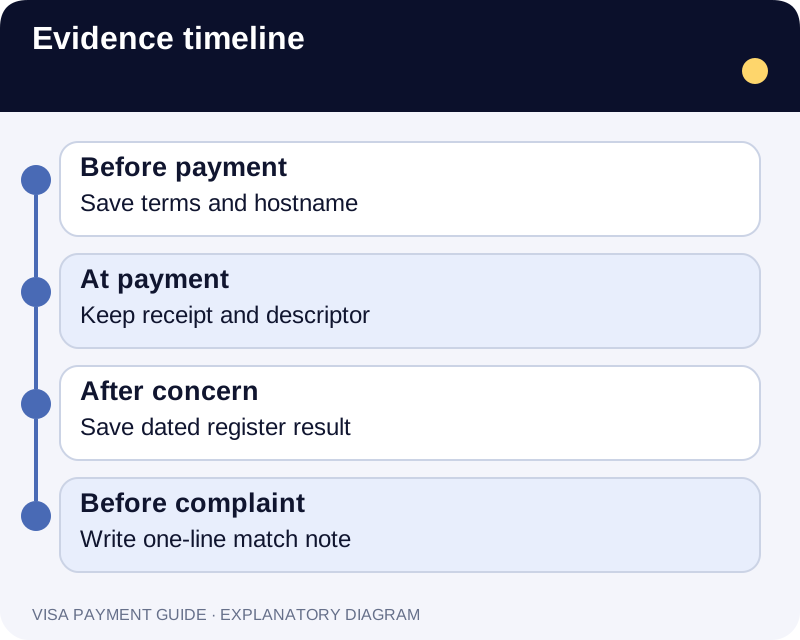
The register's account number identifies the licensed business. It is not your player account number, bank account number or payment reference. Keep payment references separately for tracing transactions. Do not enter them as the regulator's business account number.
For a card payment, keep your dispute route separate from the licence question. A licence check does not decide a refund. See card payment disputes for the bank’s process and time limits.
When the register and the website disagree
Disagreement is common and can have ordinary causes. A group may use a trading name not yet listed, or a site may show an old number. The useful step is to ask the firm to reconcile the exact strings you hold. Do not send a full identity document set in the first message.
| What you see | Possible ordinary cause | Evidence to request | Risk of jumping to a conclusion |
|---|---|---|---|
| Domain not listed under the entry | New brand, group structure or listing lag | Written link between hostname and licence holder | Calling it unlicensed without checking subdomains or terms |
| Entity in terms differs from holder | Group company provides services; another holds the licence | Contracting entity and its role in the group | Assuming the first name found is the operator |
| Licence number appears on site but search fails | Typo, old number or different jurisdiction | The exact number and the register entry it should match | Accepting a badge as proof |
| Entry shows a ceased or changed status | Transfer, surrender or later regulatory action | Status history and the date you transacted | Treating today’s status as the status on your payment date |
Ask a short, factual question: “Please confirm the legal entity that contracted with me, the licence number covering [exact hostname], and the licensed activity for my transaction.” Keep the reply. If the reply is unclear, ask again once, quoting the exact strings.
Regulatory action is not the same as licence status. An entry can remain active while a review or warning is published elsewhere. Read both the status field and any linked action. Neither tells you whether you will be paid, so do not treat either as a guarantee.
If the firm says a different company holds the licence, ask for the chain in writing. A group name is not enough. You need the entity on your contract, the entity on the licence, and the basis on which one acts for the other. This is a documentary question, not a test of the site’s design.
For a wider view of payment blocks, see why gambling payments are blocked. That topic concerns banks and processors; it does not decide whether a licence covers a domain.
Worked reasoning: an illustrative mismatch
Suppose, illustratively, a reader paid £200 to a site at play.example.com. The terms name “Example Play Ltd”, company number 00000000. The card statement shows “EXMPLE PAY”. The register search for the legal entity returns an active entry for “Example Gaming Ltd” with trading name example.com.
The reader should not conclude fraud. Three facts are known: the hostname differs, the entity differs and the statement descriptor differs. Two facts are unknown: whether play.example.com is authorised under the entry, and whether the two companies are linked. The reader should request the missing facts.
| Item | Recorded string or fact | Match? | Next action |
|---|---|---|---|
| Hostname used | play.example.com | No exact match to listed example.com | Ask which licence covers the subdomain |
| Contracting entity | Example Play Ltd, no. 00000000 | Not the holder shown | Ask for the group and agency link in writing |
| Licensed activity | Remote casino shown on entry | Product may match | Check the entry’s activity list against the product used |
| Payment descriptor | EXMPLE PAY | Differs from both names | Give bank the exact descriptor and receipt |
This example is illustrative and uses reserved domains. It is not observed customer data. Its purpose is to show how to separate a match question from a payment question. The reader can send one message to the firm and one to the bank, each with the same dated file.
Note the status issue. Suppose the entry is active today but was “ceased” on the payment date. The reader should record both dates and ask which entity held the licence when the payment was taken. Today’s status is not a time machine.
Northern Ireland deserves its own line. The Commission register covers Great Britain. A GB entry does not establish a licence for a Northern Ireland-facing service. If your address or the service is in Northern Ireland, ask the firm which regime applies and record the answer.
What a licence check cannot prove
A licence is a permission to carry on a regulated activity. It is not a promise that a firm will pay, remain solvent or resolve your complaint quickly. Treat any suggestion that a licence guarantees safety with caution, including on review sites.
- Safety: the register does not score firms or rank them.
- Solvency: status and accounts are different questions.
- Ownership: trading names supplied by firms may be incomplete or wrong.
- Your payment: a licence does not decide a card dispute or a withdrawal delay.
- Northern Ireland: a GB entry is not a blanket approval there.
If a withdrawal is delayed, keep the licence file and the transaction file separate. See withdrawal complaints for the record of requests, replies and promised dates. Do not merge the two into one long message; each channel asks different questions.
For payment mechanics, see Visa withdrawals. The licence question is about who may offer the activity. The payment question is about the transfer, the reference and the bank’s rules.
How to record and escalate a genuine gap
If your documented search finds no match, keep the wording neutral: “On [date], the exact hostname did not appear under the entry for [entity].” Say what you searched and what you found. Attach the dated copy. Do not assert a crime.
You can ask the firm to resolve a documented mismatch. You can also report suspected illegal gambling directly to the Gambling Commission; contacting the firm first is not a prerequisite for a regulatory report. Give it the exact hostname, entity, licence number and date. Set a clear reply request, but avoid inventing a deadline the firm never agreed. Keep the reply, even if it is unhelpful.
If you remain concerned about a GB-licensed business, use the Commission’s published contact route for consumers. We have not tested that route or submitted a real complaint. Describe your evidence, not your suspicions. The licence check guide is this page; use the register links below for the official search.
For a payment problem, contact your bank’s disputes team separately. Give the exact descriptor, amount, date and your dated licence note. The bank decides its own case. Do not tell the bank a licence check proves fraud, because it does not.
FAQ
Does an active register entry mean a site is safe?
No. It shows a licence is not displayed as ceased, revoked or suspended on the date you check. It does not prove solvency, fair treatment or that the exact hostname belongs to the holder. Record the status and date, then check the domain and activity separately.
Can I rely on a licence badge in a website footer?
No. A badge is a claim by the site. Type the licence number into the official register yourself. Compare the legal entity, exact hostname and licensed activity. Keep a dated copy. A real number used by the wrong site is still a mismatch worth documenting.
Is a Companies House entry the same as a gambling licence?
No. Companies House shows company registration and filings. It says nothing about permission to take bets or run a casino. Use it to match the contracting entity and company number. Then check the Gambling Commission register for licence status and activity.
What if the site lists a licence from another country?
An overseas licence may authorise activity in that jurisdiction. It does not establish cover for Great Britain. Check the GB register separately for GB-facing activity. If you are in Northern Ireland, ask which regime applies. The GB register is not a blanket answer there.
Should I report a missing domain match as fraud?
Not on that fact alone. State that the exact hostname did not match on the date checked. Ask the firm to reconcile the domain, entity and licence. Send your dated evidence to the appropriate official channel. A missing match is unresolved, not proof of a crime.
Sources and review note
We inspected the following public documents on 14 November 2026. Source publication dates differ from our review date. We did not test deposits, contact banks or submit complaints.
- Gambling Commission public register: business search — search fields and entries.
- Gambling Commission guide: what gambling businesses must do — licence duties and status context.
- Gambling Commission: about the public register — scope and limits of the register.
This page is general consumer information, not legal advice. The official register and the firm’s written reply are the primary records. Keep your own dated copies.